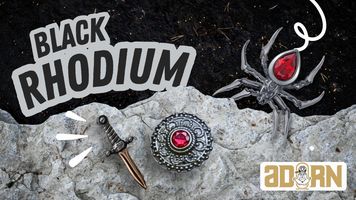
Black Rhodium, also called Black Gold, is a fun way to create a romantic, spooky curation.Whether you are looking for an all-black curation or are looking to mix metal tones, rhodium is an amazing addition.With Halloween coming up, we wanted to talk about this mysterious metal–its history, how it’s made, and how to style it–so that you can start dreaming about your new spooky setup.
History
Rhodium itself was first discovered in 1803 by British chemist William Hyde Wollaston. It would take more than a century for rhodium to be used to plate metals, however, with commercial availability starting in the 1930s. This plating was used to both improve the resistance of the jewelry against tarnishing as well as add a more lustrous, white finish to white gold, platinum, and sterling silver. Even today, most white gold jewelry is made using a rhodium electroplating finish due to its increased luster (Royce-Greensill 2025).
It wasn’t until 1982 that black rhodium appeared on the scene. Japanese inventor Masayoshi Mashiko with their team at Nippon Metal Plating Co. Ltd. saw a need for an improved method of creating black jewelry. To quote the inventor themselves: “known manners for black plating or black coloring such as black chrome plating, black nickel plating, blackening with copper carbonate all encounter difficulties in obtaining gloss, some of them yielding clouding” (Mashiko and Suzuki, 1982).
Black rhodium plating was later popularized by famous jeweler Joel Arthur Rosenthal (often referred to by his initials, JAR). Known for his inventive and unique pieces, JAR leapt at the opportunity to use a unique process with his jewelry and “sparked the renaissance of purposefully blackened diamond jewelry” (Royce-Greensill 2025). Black rhodium has since waxed and waned in popularity, depending on the fashion of the time, but seems to be rising in popularity once again.
While the history of black rhodium in the piercing industry is not written down in any official capacity, it is nearly certain that BVLA is the innovator behind bringing this method to piercing jewelry. Nick Martin, the founder and owner of BVLA, remembers seeing black rhodium at various jewelry tradeshows somewhere around the mid-to-late 2000’s. After developing and perfecting the process for manufacturing at BVLA, the first pieces of body jewelry were likely produced somewhere between 2008 and 2010.
What Is Rhodium?
As a platinum-group metal, rhodium is one of the rarest metals on earth, about four times less common than gold (“Abundance of Elements in the Earth's Crust and in the Sea” 2021, 14-21). That is only part of the reason that black rhodium comes with a slightly higher price tag, however. Rhodium, unlike gold, is rarely found in large deposits. Instead, it is mostly found in small amounts mixed among other ores and minerals in the Ural mountains and in North and South America (Hammond and Lide 2021, 4-28). This makes processing rhodium for manufacturing a more tedious process than many other metals.
While rhodium’s natural white luster and durability has made it a popular choice for improving white gold and silver, it is not malleable enough to reliably be crafted into jewelry on its own (Thompson 2025). This is, ultimately, a great thing for the consumer. Since rhodium is considered one of the most valuable metals in the world and rhodium plating is generally only about 0.75 - 1.0 microns (or .0003 inches) thick, this means that your black and white golds with a rhodium finish are much more affordable than a pure rhodium piece would be (WC Editorial Team 2023).